Disaster Recovery &
High Availability Platform
A cloud-native, application-level DR platform engineered specifically for regulated industries that demand both financial-grade recovery objectives and full on-premises control.
Executive Summary
When critical systems fail, every second costs money, reputation, and regulatory standing. UIS Cloud's Disaster Recovery & High Availability Platform — built on DCE 5.0 — is a cloud-native, application-level DR platform engineered specifically for regulated industries that demand both financial-grade recovery objectives and full on-premises control.
Unlike public cloud DR tools that recover VMs and leave your operations team to manually restart services in the right order at 3am, DCE 5.0 recovers your Kubernetes workloads — namespaces, dependencies, stateful sets, config, secrets — in the correct sequence, automatically, across every cluster and cloud you operate. No human in the loop. No manual orchestration. No missed services.
Pain Points Solved
Application Recovery Gap
Your current DR tool recovers infrastructure — not applications. After failover, your team spends hours manually identifying which services failed to start, in what order, and why. When the post-incident review happens, that gap is yours to answer for — not your vendor's.
Regulatory Mandates
DORA Article 11 requires financial institutions to demonstrate ICT continuity plans with tested, documented RTO/RPO targets. BAFIN, ACPR, and NIS2 carry equivalent mandates. If your current DR tool cannot produce a regulator-ready audit trail of your RTO/RPO performance, that is not a configuration gap — it is a compliance gap your next supervisory review will surface.
Multi-Cloud Reality
Your workloads span AWS, Azure, OCI, and on-prem. Your DR tool covers one of them. When the incident spans two — and it will — you are running manual failover procedures across environments your tool was never designed to orchestrate simultaneously. That is the scenario your DORA resilience test is designed to expose.
Foreign Control Plane
Many public cloud DR solutions route orchestration through a foreign-controlled control plane — a structural risk for regulated entities.
Manual Failover Drills
Manual failover drills take days to plan, require specialist knowledge, and still fail unexpectedly in production.
Core Capabilities
Application-Level Recovery — Not Infrastructure-Level
DCE 5.0 operates at the Kubernetes workload level. Unlike VM-based recovery — which restores an entire machine at significant cost and resource overhead — it recovers your namespaces, deployments, stateful sets, services, config maps, secrets, and persistent volumes — in dependency order — to a running, verified application state.
Cross-Cluster & Cross-Cloud Failover
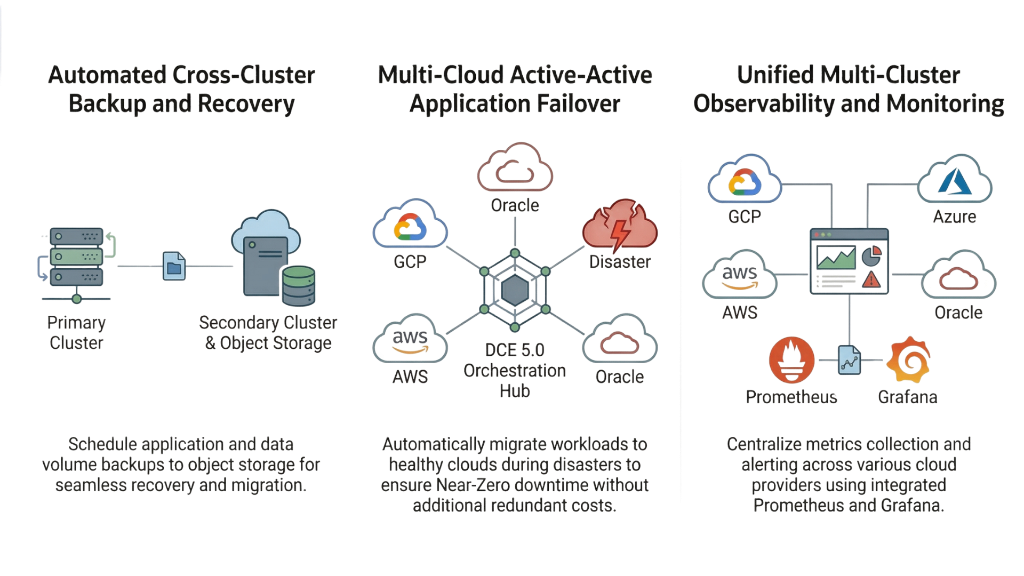
Automated failover across clusters within the same cloud, across different clouds, or across on-premises data centres. Active-Active and Active-Standby topologies are both supported, with real-time health monitoring and configurable eviction tolerances.
Configurable and Auditable RTO/RPO
Configurable cluster monitoring intervals, unhealthy grace periods, and eviction timeouts let teams define and achieve RTO/RPO targets that meet core banking and government SLA requirements. Parameters are fully auditable and reportable to regulators.
Automated Failure Detection & Failover
No human in the loop. DCE 5.0 continuously monitors cluster health. When a cluster crosses the unhealthy threshold, it is automatically tainted, eviction is initiated, and workload pods migrate to healthy clusters — all without operator intervention.
Full Backup Suite — Application & Cluster Configuration
Your backup strategy needs to answer two different failure scenarios: a single service failing in production ("surgical recovery"), and a full cluster event (complete state restoration). DCE 5.0 handles both. Namespace-level backups with label filtering for targeted service recovery. CronJob-scheduled incremental and full backups for cluster-level continuity. Every backup verifiable, auditable, and restorable to a clean application state — not just a filesystem snapshot.
Multi-Region High Availability
Purpose-built for geo-distributed deployments across availability zones and regions, enabling organisations to meet both technical HA requirements and regulatory mandates for geographic data separation.
Architecture at a Glance
DCE 5.0's DR Architecture Operates on a hub-and-spoke multi-cloud management model
DCE 5.0's DR architecture operates on a hub-and-spoke multicloud management model
Global Control Plane
A unified management cluster provides cross-cloud workload scheduling, failover policy management, and health monitoring — deployed on your infrastructure.
Member Clusters
Production, standby, and DR clusters in any cloud or on-premises environment register as managed members. Scheduling policies (aggregated or dynamic-weight) govern normal operations.
Failover Engine
Continuous ClusterMonitor polls registered clusters. On unhealthy detection exceeding grace period, the engine taints the cluster, drains pods via graceful eviction, and reschedules to available healthy clusters using remaining capacity.
Backup Controller
CronJob-driven backup scheduler persists full and incremental snapshots of application namespaces and etcd state to your designated storage backend — S3-compatible, on-prem NFS, or private object store.
Recovery Orchestrator
Namespace-level restore with label selector filtering enables surgical recovery of specific services without touching adjacent workloads — minimising blast radius and recovery time.
Deployed on your infrastructure
No mandatory call-home to UIS Cloud infrastructure
Regulated industries cannot afford DR theatre — tools that look good in demos but fail the audit test, the compliance test, or the 3am production incident test. DCE 5.0, having passed 1000+ references worldwide, was built by engineers who live in cloud-native infrastructure, for organisations that cannot afford to get it wrong.
Request a DR Assessment
Get in touch with our team and we will map your current DR posture against DORA/NIS2 requirements, identify your recovery gaps, and show you exactly how DCE 5.0 closes them — on your infrastructure, on your timeline.
"Your data stays in your environment on Day 1.
Your regulators will thank you on Day 2."