GPU & Inference Optimization
The GPU Efficiency Engine
A Six-Step Framework to Reach 95% GPU Utilization
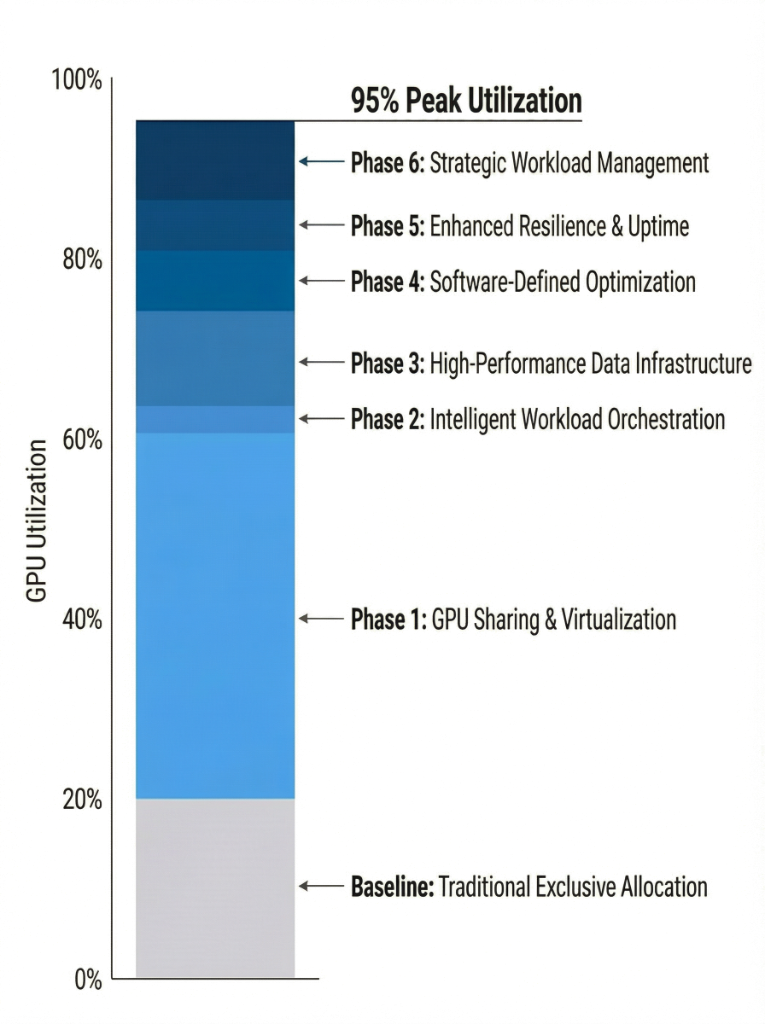
From a ~20% baseline utilization to near-total optimization, the GPU Profit Engine is a systematic framework for unlocking the full technical and economic value of GPU infrastructure.
WHY GPU OPTIMIZATION?
The GPU Utilization Problem
Traditional GPU environments are built around exclusive allocation. A single workload often reserves an entire GPU, even when the task is lightweight or intermittent.
As a result:
- •Average GPU utilization remains around 15–25%
- •The majority of deployed compute capacity sits idle
- •GPUs still incur 100% of capital, power, cooling, and depreciation costs
Idle GPUs are not inactive assets.
They are depreciating, power-consuming assets.
GPU optimization exists to eliminate this structural inefficiency.
HOW GPU OPTIMIZATION WORKS
The GPU Efficiency Engine: Six Steps to 95% Utilization
The GPU Efficiency Engine increases utilization progressively through six cumulative optimization steps. Each phase removes a specific bottleneck that prevents GPUs from operating continuously.
I. FOUNDATIONAL OPTIMIZATION
Triple Utilization by Solving Resource Fragmentation
GPU Sharing & Virtualization
Problem:
Lightweight tasks monopolize entire GPUs. A single inference job can block a GPU that is capable of serving dozens of concurrent workloads.
What Changes:
GPU sharing and virtualization technologies allow a single physical GPU to be safely partitioned and time-shared across multiple workloads.
Technical Effect:
- Multiple jobs execute concurrently on one GPU
- Workload density increases dramatically
- GPUs are no longer idle while waiting for single tasks to complete
Outcome:
Utilization increases from ~25% toward ~75% in shared workload environments.
Intelligent Workload Orchestration
Problem:
Even with GPU sharing, poor scheduling creates idle gaps between workloads.
What Changes:
Workload orchestration systems apply bin-packing, dynamic scheduling, and intelligent batching to coordinate inference and training workloads.
Technical Effect:
- GPUs process work continuously rather than in bursts
- Idle gaps between jobs are eliminated
- Mixed workloads coexist efficiently
Outcome:
Sustained utilization rises toward ~90%.
II. ADVANCED OPTIMIZATION
Eliminate Data and Software Bottlenecks
High-Performance Data Infrastructure
Problem:
GPUs frequently stall while waiting for data. This is known as the data hunger problem.
What Changes:
High-performance data pipelines using RDMA-enabled networks, GPUDirect Storage, and optimized memory paths allow data to move directly from storage to GPU memory.
Technical Effect:
- Data I/O latency is reduced
- GPUs no longer idle while waiting for input
- Training and inference pipelines run at sustained throughput
Outcome:
Model training times can be reduced by more than 50%, reclaiming GPU time that would otherwise be lost to I/O waits.
Software-Defined Optimization
Problem:
Even with perfect hardware and data flow, inefficient software limits GPU throughput.
What Changes:
Software-level optimizations including advanced inference runtimes, dynamic batching, model parallelism, and precision optimizations.
Technical Effect:
- More work is executed per GPU cycle
- Throughput increases without adding hardware
- Compute efficiency improves at the application level
Outcome:
Effective compute output per GPU increases significantly, enabling up to 24× more billable compute output compared to exclusive execution models.
III. OPERATIONAL EXCELLENCE
Capture the Final 10% for Near-Total Utilization
Enhanced Resilience & Uptime
Problem:
Failures, restarts, and crashes waste large amounts of GPU time, especially during long training jobs.
What Changes:
Operational resilience through intelligent auto-scaling, automated failure recovery, and asynchronous checkpointing.
Technical Effect:
- GPU time lost to failures is minimized
- Training jobs resume without full restarts
- Idle recovery windows are eliminated
Outcome:
Wasted GPU time is reduced by 30–50%, pushing utilization closer to practical limits.
Strategic Workload Management
Problem:
Even optimized clusters experience demand cycles, leaving GPUs idle during off-peak periods.
What Changes:
Strategic workload alignment with inference-heavy workloads during peak hours and compute-intensive training during off-peak hours.
Technical Effect:
- GPUs operate close to 24/7 utilization
- Idle capacity is systematically filled
- Cluster utilization stabilizes at maximum sustainable levels
Outcome:
Overall GPU utilization reaches 90–95% practical utilization.
WHAT GPU OPTIMIZATION DELIVERS
When all six phases are applied together:
Utilization Impact
GPU utilization increases from ~20% to 90–95%, representing a 4–5× improvement.
Compute Output
A single GPU can deliver up to 24× more billable compute output through sharing, orchestration, RDMA-based data pipelines, and software optimization.
Revenue Impact
Optimized environments can achieve ~25× revenue uplift compared to bare-metal GPU leasing when high utilization is combined with service-based monetization models.
Economic Transformation
GPU infrastructure transitions from a cost center into a scalable, service-oriented profit engine.
Transform Your GPU Infrastructure into an Efficiency Engine
Discover how the GPU Profit Engine can revolutionize your AI infrastructure economics.